Top 10 Craziest Moon Impact Theories—What Science Actually Says
The Moon is one of the most mysterious things in our night sky. 🌙
We’ve looked at it for thousands of years, made poems about it, and even landed on it… yet, when it comes to how the Moon got here, there are more wild theories than you might think.
Some of these ideas sound like straight-up science fiction, while others are backed by real evidence.
Let’s break down the top 10 craziest Moon impact theories — and see what scientists actually say about them.

1. The Giant Impact Hypothesis (The Leading Theory)
This is the theory most scientists agree on. About 4.5 billion years ago, a Mars-sized planet called Theia crashed into Earth.
The impact threw a massive amount of rock and dust into space, which later clumped together to form the Moon.
It’s a big, dramatic event — and it explains why Moon rocks are so similar to Earth rocks.
| Evidence | Explanation |
|---|---|
| Moon rocks match Earth’s crust | Suggests the Moon came from Earth material |
| Computer simulations | Show the collision could create a Moon-sized body |
| Isotope ratios | Similar between Moon and Earth |
Still, even though this theory is popular, it’s not perfect — some chemical details don’t match up.
2. The Double Impact Theory
Imagine two huge space collisions instead of one. 🚀💥
This idea says that Earth was hit twice in quick succession.
The first collision partly formed the Moon, and the second impact shaped it into what we see today.
Some scientists think this could explain the Moon’s unusual internal structure. But… so far, the evidence is limited.
3. The Capture Theory
This one’s fun to imagine — the Moon wasn’t born here at all.
It formed somewhere else in the Solar System, wandered too close to Earth, and got “captured” by our gravity.
Sounds like a space romance, right? The problem?
Physics says capturing such a big object would need a very special set of conditions — and there’s no solid proof it happened.
4. The Fission Theory
In this idea, Earth was spinning so fast billions of years ago that a chunk of it literally spun off into space.
That chunk became the Moon. 🌏➡🌕
It’s an old theory from the late 1800s and explains why the Moon’s rocks are similar to Earth’s.
But scientists found Earth couldn’t have spun fast enough for this to happen without breaking apart entirely.
5. The Synestia Hypothesis
This one sounds like sci-fi but it’s backed by new simulations.
A synestia is a giant, spinning, donut-shaped cloud of vaporized rock. After a huge impact, Earth might have briefly turned into this shape.
The Moon then formed inside that hot, swirling cloud. 🌪🔥
It’s a wild mental picture — and could explain why Earth and Moon materials match so closely.
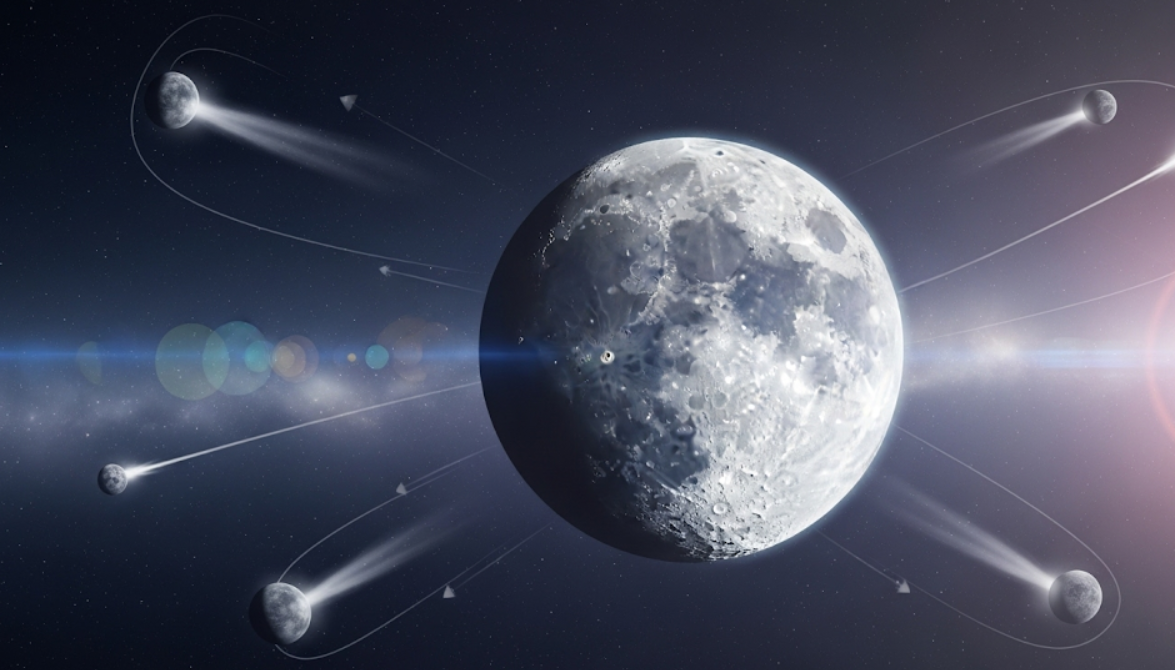
6. The Multiple Moon Theory
What if… there used to be more than one Moon?
Some scientists think a big impact might have created two moons. Over time, the smaller one slowly crashed into the bigger one — giving the Moon its lopsided shape.
This could explain why the far side of the Moon looks so different from the side we see.
7. The Alien Mega-Structure Theory 👽
Alright, this one is purely in the “crazy but fun” category.
Some conspiracy theorists believe the Moon is actually hollow — built by aliens as a giant space station.
They point to strange Moon “ringing” sounds recorded during Apollo missions. Scientists say this “ringing” is just how the Moon’s surface vibrates after impacts — but the alien base theory refuses to die.
8. The Comet Impact Shaper
This isn’t about how the Moon formed, but how it got its final look.
Some researchers suggest that massive comet strikes shaped the Moon’s basins and mountains more than asteroid impacts did.
Comets move faster and carry ice, which could have left traces of water in Moon soil — something scientists have indeed found.
9. The Magma Ocean Impact Idea
Right after the Moon formed, its surface may have been a deep ocean of molten rock. 🌋
Big impacts during this time would have left huge craters that reshaped the entire crust.
This explains the strange mix of light and dark regions on the Moon’s surface.
10. The Planetary Ring to Moon Theory
Think of Saturn’s rings — now imagine early Earth had something similar after a giant impact.
Over time, chunks from that ring clumped together into a single large Moon.
It’s like building a snowball — except the “snow” was molten rock and dust floating in space.
What Science Actually Says
While many of these theories are imaginative, most scientists still lean toward some version of the Giant Impact Hypothesis — possibly with a twist, like synestia formation or multiple impacts.
Here’s a quick summary:
| Theory | Likelihood | Main Issue |
|---|---|---|
| Giant Impact | High | Some isotope mismatches |
| Double Impact | Medium | Needs more proof |
| Capture Theory | Low | Physics makes it unlikely |
| Fission Theory | Very low | Earth couldn’t spin that fast |
| Synestia | Medium-High | New concept, still being tested |
| Multiple Moons | Medium | No direct fossil evidence |
| Alien Structure | None (fun only) | No proof at all |
| Comet Shaping | Medium | Hard to tell comets from asteroids |
| Magma Ocean Impact | High | Supported by rock analysis |
| Ring to Moon | Medium | Fits models, needs more data |
Final Thoughts
The Moon’s origin story is still being written.
Every new space mission gives us fresh clues, and it’s possible that the real answer is a mix of several of these theories.
One thing is certain — the Moon’s history is far more dramatic than just “floating up there.” It’s a survivor of cosmic chaos, a time capsule from the early Solar System… and maybe the reason life on Earth even had a chance. 🌍❤️🌕
Also check out: Top 7 Moon Missions That Changed Space Exploration Forever